

Back
Blog
12 Moves That Matter: An AI Playbook for Small Business Operators
By Dobbin Bookman | June 2, 2026
You Learned How to Prompt. Now Build an Operating System.
If you read my last post, Talk With It, you walked away knowing that the key to better AI output is treating your chatbot like a brilliant intern: give it a clear assignment, add context, and refine through conversation. That was Prompt Engineering 1.0, and it is foundational.
But here’s what I’ve learned since then, working with hundreds of small business owners across the country: knowing how to write a good prompt isn’t the same as knowing how to use AI to help you run your business.
The distance between the two is in the application.
From “Check This Out” to “This Is How We Operate”

Think about where you were two years ago with AI. Most of us were in the “wow” phase, copying and pasting things into ChatGPT just to see what it could do. Maybe you drafted an email or asked it to create an image. Fun? Sure. Operational? Not so much.
Then, sometime between 2024 and 2025, something shifted. AI went from party trick to the potential to be an actual tool. You started delegating real tasks, drafting RFPs, analyzing customer feedback, building job posts. You started to see real use cases.
Now it’s 2026, and the operators who’ve pulled ahead aren’t just prompting better. They’re building systems. They’re turning one-off AI outputs into repeatable templates, then into SOPs, then into review loops that make their entire operation sharper. These operators are experiencing increased efficiency and overall workflow optimization that ultimately leads to higher performance.
That’s what the 12 Moves are about.
The 12 Power Moves: A Framework for AI That Works
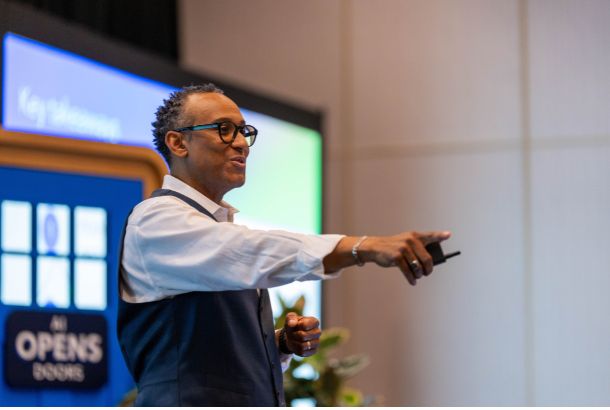
I developed these 12 Moves through my own experience with AI, and from workshops, client sessions, and live facilitation with real business owners.
The Moves are organized into three groups, and each group represents a shift in how you relate to AI:
“AI won’t replace strategic operators. But operators who use AI will outperform those who don’t.”
GROUP 1: PRECISION — Make AI Know What Job It’s Doing

The most common mistake I see? People open ChatGPT and type something vague like “help me write a marketing plan for my HVAC business.” That’s not an assignment, that’s a wish. Precision is about giving AI enough to actually perform.
Move 1: Name the Job. Don’t ask for help, assign a role. Instead of “give me marketing ideas,” try: “Act as a growth marketer for a 20-person HVAC company in the Midwest.” When you name the job, AI stops guessing and starts working.
Move 2: Define “Done.” What does a good output look like? Tell it. “Create 3 options. Include cost, effort, risk, and the first 3 steps for each.” If you don’t define the finish line, AI will write you a novel when you needed a memo.
Move 3: Add Context. Industry. Company size. Constraints. Audience. Geography. Your website URL. Context is the difference between a generic answer and a useful one. When I add context to a prompt, the output quality improves dramatically, every time.
Move 4: Show Your Inputs. This is the unlock. Stop requiring AI to guess your business. Paste in your actual customer complaint logs, staff schedules, meeting notes, financial snapshots, job descriptions, inventory data, whatever’s relevant. AI gets 10x better when it has your real information to work with, not hypotheticals. This single move transforms output from “interesting” to “actionable.”
GROUP 2: THINKING — Make AI Think Like an Operator

Once AI knows the job, the next step is getting it to think the way you think, as an owner/operator weighing options, surfacing risks, and making decisions with tradeoffs in mind.
Move 5: Constrain the Format. “Return as a table.” “Keep it under 200 words.” “Give me bullets, not paragraphs.” Constraints are clarity. You need useful information, not more information.
Move 6: Surface Assumptions. This one is underrated. Add the line: “List the assumptions you made.” Even better, ask AI to act as your critical mentor: “Push back on my thinking, surface assumptions, flag risks, and tell me what I may be missing.” You’ll be surprised how often AI is operating on assumptions you’d never accept, or politely validating a direction that needs more scrutiny. This move helps prevent bad strategic decisions before they happen.
Move 7: Ask for Options, Not Answers. Never ask AI “What should I do?” Always ask: “Give me 3 approaches– conservative, balanced, and aggressive. Show tradeoffs for each.” You’re the decision-maker. AI is the analyst. Keep it that way (for now).
Move 8: Force Tradeoffs. For every option, require: cost, risk, difficulty, and ROI timeline. This is the move that turns a response from Claude or ChatGPT into something you’d actually present to your team or your board.
GROUP 3: OPERATIONALIZING — Make AI Part of Your Operating System

This is where the real leverage lives. Groups 1 and 2 will get you a great output. Group 3 turns that output into a system.
Move 9: First Draft → Improve. Never stop at version one. Say: “Make it 30% shorter.” “Show me 3 more drafts.” “Now rewrite this for a non-technical audience.” Iteration is where good becomes great.
Move 10: Turn Output into Template. If you use a prompt twice, template it. That follow-up email that worked? That job post that attracted great candidates? Save the prompt structure. Don’t “threepeat” work.
Move 11: Turn Template into SOP. Document who runs it, when they run it, what inputs are needed, and what good output looks like. Replicate it and propagate it. Don’t duplicate it.
Move 12: Build a Review Loop. Every AI output needs a human checkpoint. Is the price correct? Does it sound like us? Does it make a promise we can keep? Check for accuracy, bias, compliance, and tone.
The 12 Moves in Action: Three Scenarios

These are the kinds of problems real small business owners bring to my workshops. Notice how each scenario layers multiple Moves together.
Scenario 1: 40 Customer Complaints → 60-Day Action Plan
The old way: 3 hours reading through complaints, guessing at patterns, drafting a plan from scratch. The new way: 10 minutes.
“Act as an operations analyst for a quick-service restaurant with 4 locations in North Carolina. Goal: Reduce complaints 30% in 60 days. Here are 40 complaints: [paste actual files]. Categorize themes. Identify root causes. Recommend 3 fixes with effort, cost, and risk. Output as a 60-day action plan with weekly milestones.”
What you get: complaint themes identified, root causes surfaced, three operational fixes with tradeoffs, a 60-day action plan with milestones, and a meeting agenda for your team. That’s Moves 1, 2, 3, 4, 5, 7, and 8 all working together in one prompt.
Scenario 2: From Job Post to 90-Day Onboarding Plan — One Prompt
You need to hire. You don’t have an HR department. You’re busy running 4 locations.
“Act as an HR leader for a 25-person landscaping business. Create a complete hiring package for a crew lead: Job post (under 250 words), interview guide (10 questions), scoring rubric (1–5 scale), 30-60-90 day onboarding plan. Context: 4 crews, role manages 5–6 people, 3+ years required, bilingual preferred, clean driving record. Paying up to $30/hour. Here’s a link to our website.”
One prompt. Four deliverables. Rinse and repeat for every role you hire.
Scenario 3: Executive-Level Thinking on Demand
You’re facing a big decision– expand into new territory, hire, invest in equipment. You don’t have a CFO. But you can think like one.
“Act as a CFO for a $2M home services business. We’re considering expanding into neighboring counties. Current metrics: $2M revenue, 18% margin, 48 jobs/month, average job $3,500. Create a one-page decision memo: summary (3 sentences), 3 options (conservative/moderate/aggressive), risks for each, recommendation with reasoning and assumptions, next 5 actions. Format as a table.”
What you get is three strategic options, a risk assessment, a clear recommendation, and an action plan. AI as becoming a thinking partner, and not just a writing tool.
The Real Pro Tip: One Task at a Time

Here’s what I’ve said in every session: Don’t “implement AI.” Don’t build “an AI strategy”, unless you have a “Google”, “Hammer”, or “Screwdriver” strategy. AI is a tool, a means to an end, not the end itself.
Instead, do this:
Pick one task you repeat weekly. Build a prompt using just 2 of the 12 Moves. Test the output on real work. If it works, template it. Then rinse and repeat.
My recommendation? Start with Move 4 (Show Your Inputs) and Move 7 (Ask for Options). Those two moves alone will change your relationship with AI overnight.
Three Copy-Paste Prompts to Get You Started
Customer Complaints → Action Plan: “Act as an operations analyst. Here are [X] complaints: [Paste here]. Categorize themes. Identify root causes. Recommend 3 fixes with effort/cost/risk. Output as a 60-day action plan.”
Complete Hiring Package: “Act as an HR leader for a [SIZE]-person [INDUSTRY] business. Create a hiring package for [ROLE]: job post (<250 words), interview guide (10 Qs), scoring rubric (1–5), 30-60-90 plan. No biased language.”
Decision Memo: “Act as a CFO for a $[REVENUE] [INDUSTRY] business. We’re considering [DECISION]. Create a one-page decision memo: summary, 3 options with tradeoffs, risks, recommendation, and next 5 actions. Format as a table.”
What’s Next? Agents and Agentic AI
In the first post, I teased agentic AI. Now it’s arriving. We went from chatbots you prompt (Level 1), to workflows you design (Level 2), to agents that reason, act, and iterate on your behalf (Level 3).
Most businesses are still at Level 1. The biggest wins today are at Level 2, building repeatable workflows with AI embedded. However, Level 3 is where it’s all heading, and the operators who’ve built the habits in the 12 Moves will be best positioned to get there.
More on agents soon. For now, master the Moves. The foundation you build today is the infrastructure you’ll scale tomorrow.
My Challenge to You
Before you close this tab:
- Pick one task you repeat weekly.
- Build one prompt using 2 of the 12 Moves
- Test it on real work
- Report back to someone on your team
 Dobbin Bookman is the Director of AI Initiatives at ICIC, where he leads efforts to harness the transformative potential of artificial intelligence to drive inclusive economic prosperity for small businesses and under-resourced communities. Experienced as an entrepreneur, facilitator, and global advisor, Dobbin brings a wealth of knowledge and practical insights to leveraging technology for transformative business practices.
Over the past 20 years, Dobbin has developed innovative learning paths for managers and senior leaders, focusing on optimizing human capital capacity and aligning talent with organizational objectives. His guiding principle, “Don’t manage your people, manage the backdrop against which they work,” reflects his commitment to creating environments that foster peak performance.
At ICIC, Dobbin has been instrumental in conducting focus groups and research in partnership with Intuit, aiming to revolutionize small business operations through cutting-edge AI solutions. These initiatives empower entrepreneurs, particularly those from underrepresented communities, by equipping them with tools and education to thrive in an AI-driven economy.
Connect with Dobbin at www.dobbinbookman.com and https://www.linkedin.com/in/dobbinbookman/